
Sub-Total: $0.00

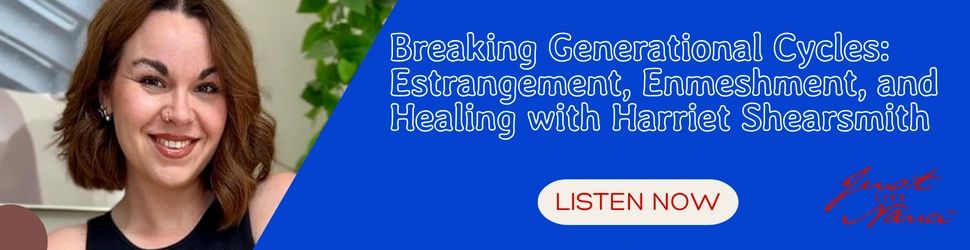
Harriet Shearsmith talks about the balance of wanting to honor our ancestors while drawing firm boundaries against destructive behaviors.
Harriet explores how ancestral trauma is unintentionally passed down through generations, share stories of personal family estrangements, and dive deep into what it truly means to be a cycle breaker.
About Harriet
Harriet Shearsmith is an accredited empowerment and life coach, trainee therapist, best-selling author, and content creator of over 10 years. She specialises in working with clients who have experienced childhood trauma and are navigating estrangement or toxic family relationships. Harriet is an award-winning blogger and writer of Unfollowing Mum (Nov.2024) and Mummin’ It (2021), and has written for and been featured in publications like Happiful Mag, Guardian, Telegraph, BBC, Daily Express, Metro, Internet Matters and more. Harriet is also an award-winning blogger, content creator behind @unfollowing_mum and @harrietshearsmith, and podcaster with over 250,000 social media followers and 100,000 downloads.
Breaking the Cycle: The Ultimate Act of Honoring Your Ancestors
The heart of Just Like Nana is centered on honoring those who came before us. We spend so much of our time here digging into the stories of our grandmothers, tracing the resilience of our lineage, and finding the gold in our family history. And sometimes, the most profound way to honor your ancestors isn’t by repeating their patterns, but by having the courage to break them.
I recently had a transformative conversation with Harriet Shearsmith—an empowerment coach, trainee psychotherapist, and the voice behind Unfollowing Mum. We sat down to talk about something that many feel is “taboo” in the world of genealogy and family history: family estrangement and the heavy, often silent burden of generational trauma.
If you’ve ever felt like the “black sheep” or the “difficult one” because you refused to stay silent about unhealthy dynamics, this episode is for you.
The Dual Truth of Ancestry
In our community, we talk a lot about “walking in someone else’s world.” We acknowledge that our ancestors lived through eras of scarcity, war, and societal pressures we can barely imagine. We hold space for the fact that they did the best they could with the tools they had.
But here is the “and” that we must also hold: we can want to honor our ancestors, and we can acknowledge that some of those family members—past or present—wreaked havoc. We can have empathy for their struggles, and we can choose not to continue a relationship that is destructive to our mental health or the safety of our children.
Harriet and I discussed how people often feel a sense of “ancestral debt.” We feel we owe it to the line to keep the peace. But true peace isn’t the absence of conflict; it’s the presence of safety. When we stop the “sneaky cycles” of trauma, we aren’t betraying our family; we are protecting its future.
Identifying the “Sneaky Cycles”
One of the most enlightening parts of my talk with Harriet was her description of how trauma evolves. It’s rarely a carbon copy from one generation to the next. Instead, it’s a “sneaky” thread.
In one generation, it might look like a “stiff upper lip” and the total repression of emotions. In the next, it might manifest as a hyper-critical focus on body image or academic success. The outward behavior changes, but the underlying message remains the same: “Your worth is conditional. Your feelings are a burden.”
As cycle breakers, our job is to develop the “eagle eye” needed to spot these threads. It’s about asking: Why do I feel a surge of anxiety when I disagree with a parent? Why do I feel the need to perform for love? When we identify these patterns, we stop being passive recipients of our history and start becoming active architects of our future.
The Catalyst of Parenting
For many of us, the drive to heal becomes urgent when we have children of our own. Becoming a parent often provides a “fierce” clarity.
Suddenly, you look at your own child and realize you would never dream of treating them the way you were treated. You realize that “that’s just how they are” is no longer an acceptable excuse for behavior that hurts. We become cycle breakers because we refuse to pass the baton of pain to the next runner.
However, this path comes with its own brand of grief. When you start setting boundaries, you might be met with gaslighting or a lack of accountability. It is heartbreaking to realize that some people would rather lose a relationship with you than admit they caused harm.
But as Harriet so poignantly said during our interview: “No one is entitled to you just because they are titled to you.”
The Power of Rupture and Repair
One of the biggest fears I hear from listeners is the fear of “getting it wrong.” We worry that if we don’t heal perfectly, we aren’t actually breaking the cycle.
I want to release you from that burden right now.
Being a cycle breaker doesn’t mean being a perfect person or a perfect parent. It means being a person who values accountability. It’s about the “rupture and repair.” When we mess up, we have the courage to look at our children (or our partners, or ourselves) and say, “I am sorry. I was wrong. I’m owning my stuff.”
That single act of humble repair is a generational earthquake. It is something many of our ancestors were never allowed (or never chose) to do.
Healing as Community Work
The journey of a cycle breaker can be incredibly lonely. When you step out of a dysfunctional family system, the system often tries to pull you back in, or cast you out entirely. This is why community healing is so vital.
We need spaces like Just Like Nana where we can be honest about the messy parts of our heritage. We need to know that choosing ourselves isn’t selfish; it’s the most honorable thing we can do for the generations yet to come.
Resources
Dr. Emma Svanberg: https://dremmasvanberg.com/
Connect with Harriet
- Website: https://harrietshearsmith.com/
- @harrietshearsmith on Instagram: https://www.instagram.com/harrietshearsmith/?hl=en
- Unfollowing Mum Podcast: https://harrietshearsmith.com/podcast/
- @unfollowing_mum on Instagram: https://www.instagram.com/unfollowing_mum/
- TikTok: https://www.tiktok.com/@itsharrietshearsmith
- Harriet’s Books: https://www.amazon.co.uk/stores/Harriet-Shearsmith/author/B08N6LV3ND?ref=sr_ntt_srch_lnk_1&qid=1738847828&sr=1-1&isDramIntegrated=true&shoppingPortalEnabled=true
Connect with the Show
Do you have a story about your family? We want to hear from you!
- Website: justlikenana.com
- Share Your Story: If you have a family story or trauma you’re exploring, reach out via our website for a chance to be interviewed.