
Sub-Total: $0.00

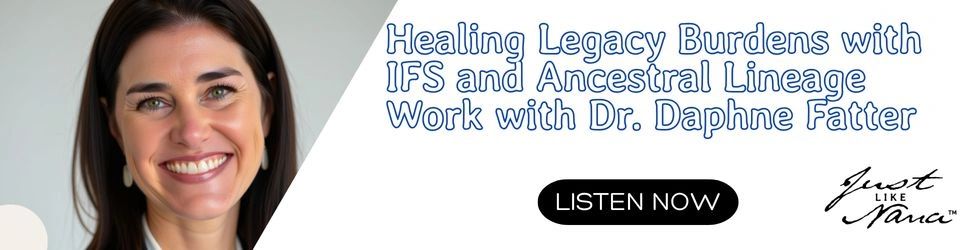
Dr. Daphne Fatter explains the world of Internal Family Systems (IFS) and its link to ancestral healing.
Trauma isn’t just a personal experience but a legacy burden that can be handed down through DNA, attachment patterns, and energetic imprints. The flip side is that we can also be the recipients of ancestral gifts.
About Dr. Daphne Fatter
Dr. Daphne Fatter is a licensed psychologist, clinical trainer, and international speaker specializing in integrative, trauma-informed therapies. As a certified practitioner in IFS, EMDR, and Ancestral Lineage Healing, she is a leading expert in resolving complex intergenerational and historical trauma. Dr. Fatter has authored significant works on these topics, including a book chapter on integrating IFS with ancestral healing and her own guide, Integrating Internal Family Systems into EMDR Therapy. Her work bridges the gap between evidence-based psychotherapy and the profound, often non-verbal realm of ancestral connection.
Maybe it started with a heaviness you couldn’t quite name. That feeling where you’re carrying a backpack full of stones, but you don’t remember putting them there? For a long time, I thought that was just what it felt like to be human. But through my own journey and the conversations we’ve been having here on Just Like Nana, I’ve begun to realize that many of those “stones” aren’t ours to carry. They belong to the people who came before us.
I recently had the honor of sitting down with Dr. Daphne Fatter, a psychologist and expert in Internal Family Systems (IFS) and Ancestral Healing. Our conversation gave an interesting perspective on how we understand trauma, resilience, and the very DNA we carry.
What Is Trauma, Really?
Dr. Fatter and I discussed the definition of trauma. We often think of trauma as a singular, catastrophic event. But Dr. Fatter explained that trauma is anything that happens that is “too much, too fast, or too soon” for our nervous system to process.
It’s about the capacity of our system to cope. When that capacity is overwhelmed, the experience gets “stuck” in our bodies. And here’s the kicker: that stuck energy doesn’t necessarily stop with us. It can be passed down through “legacy burdens.”
The Science of the “Hand-Me-Down”
We talk a lot about physical traits being passed down—Nana’s eyes, or your father’s chin. But we rarely talk about the emotional inheritance we receive.
If your grandmother lived through a period of intense scarcity or systemic oppression, your nervous system might be “pre-set” to a higher level of vigilance or anxiety, even if you’ve never experienced that kind of hardship yourself. It’s a survival mechanism that has outlived its usefulness. We are literally carrying the survival strategies of our ancestors in our cells.
The Power of “Well” Ancestors
This was the part of our conversation that really shifted something for me. When we think about family history, we often focus on the “unwell” ones—the ones who struggled with addiction, the ones who were absent, or the ones who caused harm. It can make “ancestral work” feel heavy and even dangerous.
But Dr. Daphne introduced a beautiful concept: connecting with the “well” ancestors. These are the ones who lived long before the recent trauma, the ones who are now in a state of wholeness in the ancestral realm. They are our support system.
She reminded me that for every ancestor who struggled, there are thousands behind them who survived, thrived, and passed down resilience. We don’t have to do this healing work alone. We can call on the “well” ones to help us hold the weight of the “unwell” ones. It’s about lineage repair, not just personal fixing.
Moving More Gently
As I’ve started to integrate these ideas into my own life, I’ve noticed a shift. I told Dr. Daphne during our interview that the best way I can describe it is that I’m “moving about more gently.”
When I realize that a sudden wave of grief or a sharp edge of anxiety might be a “legacy burden,” I don’t judge myself as harshly. I can say to that part of me, “I see you. I know you’re carrying something old. You don’t have to hold it all by yourself anymore.” By doing this work, we aren’t just healing ourselves. We are stopping the transmission. We are ensuring that the next generation doesn’t have to carry the same stones we did. It’s a form of communal and cultural repair. As Dr. Daphne said, healing one person at a time leads to the healing of the collective.
How to Start Your Own Journey
If this resonates with you, you don’t need a PhD or a time machine to start. Here are a few ways to begin exploring your own lineage:
- Notice the “Too Big” Reactions: When you have an emotional reaction that feels disproportionate to what’s happening, get curious. Ask, “Is this mine, or is this older?”
- Look for the Resilience: Instead of just looking for the trauma in your family tree, look for the strengths. Who were the storytellers? Who were the survivors? Who had the green thumb? These are your ancestral gifts.
- Practice Compassion: Remember that your ancestors were often doing the very best they could with the limited tools and immense pressures they faced.
Healing is a process, and it’s never linear. But I truly believe that by looking backward with compassion, we gain the freedom to move forward with grace.
I am so grateful to Dr. Daphne Fatter for sharing her wisdom with us. If you want to hear the full, deep-dive conversation, make sure to listen to Episode 10 of Just Like Nana.
Resources Mentioned
- IFS Integration by Jenna Riemersma: https://a.co/d/08wsDuTj
- Dr. Daniel Foor: https://ancestralmedicine.org/bio/
Connect with Dr. Daphne Fatter
- Website: https://www.daphnefatterphd.com/
- Integrating IFS (Internal Family Systems) into EMDR Therapy: https://a.co/d/0dKkitKs
Connect with the Show
Are you curious about the “Elizabeths” in your own family tree? We want to hear from you!
- Website: justlikenana.com
- Share Your Story: If you have a family story or trauma you’re exploring, reach out via our website for a chance to be interviewed.