
Sub-Total: $0.00

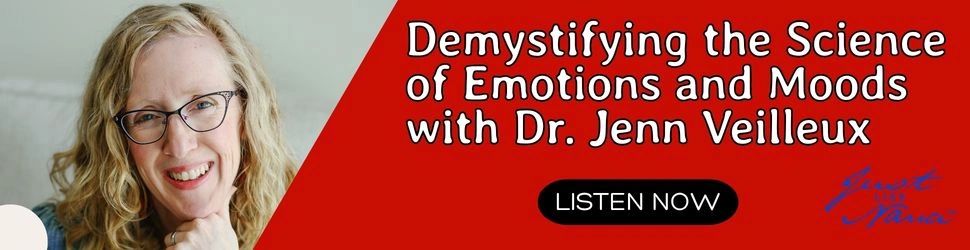
Dr. Jenn Veilleux, clinical psychologist and professor of psychological science, teaches us about the science of emotions.
Explore why we are so fundamentally afraid of negative emotions, how contrast avoidance blocks us from tasting joy, and learn a highly actionable framework to accurately interpret the hidden messages your body is trying to send you.
About Dr. Jenn Veilleux
Dr. Jenn Veilleux is a licensed clinical psychologist and a professor of psychological science at the University of Arkansas, where she specializes in emotions, emotion regulation, and personality. In addition to training graduate students in the art of psychotherapy, Dr. Veilleux operates a private practice helping adults and couples transform their relationships with their internal states. As a dedicated emotion scientist, she bridges strict empirical research with practical clinical application to help individuals understand their minds and bodies more gracefully. She is also the author of an upcoming book designed to clearly demystify the psychological science behind emotion regulation, which will be fully linked in our resources below.
The Science of Emotions and the Power of Storytelling
Part 1: Befriending the Wave — Demystifying Emotions and Moods
Do you find yourself treating your unpleasant emotions like toxic intrusions that need to be locked away or intellectualized out of existence? Many of our listeners face the exhausting pain point of cutting themselves off at the neck—overthinking their internal states rather than safely allowing them to wash through their bodies. The reality is that when we suppress our emotional responses, we aren’t actually erasing them; we are just forcing them to get louder and stronger to capture our attention.
In this enlightening episode of Just Like Nana, we sit down with licensed clinical psychologist and emotion scientist Dr. Jenn Veilleux to break down the precise boundaries between emotions, feelings, and moods. We explore why we are so fundamentally afraid of negative emotions, how “contrast avoidance” blocks us from tasting joy, and a highly actionable framework to accurately interpret the hidden messages your body is trying to send you.
The ABLE Framework for Feeling Your Feelings
The next time your internal state feels off, can you stop, take a big sigh out, and walk yourself through the ABLE framework to map the physical sensation to its true name?
- A – Aware: Notice that an internal shift or physical change is taking place.
- B – Body: Interrogate your physical form to locate where the tension, clenching, or fluttering is sitting.
- L – Label: Give the emotion a precise category name (e.g., anxiety, guilt, sadness) to let your brain process it.
- E – Explore: Investigate the cognitive message behind the trigger and gracefully decide who is driving your behavior.
Part 2: Healing the Past — Storytelling and Deep Listening
What does it mean to carry the weight of history that isn’t entirely our own? How do we navigate the inherited pain of our ancestors while forging our own path toward a future defined by healing rather than repetition? In a recent episode of Just Like Nana, host Amie Penny Sayler sits down with acclaimed author Elizabeth Rosner to explore these profound questions, examining the redemptive power of storytelling and the life-changing practice of deep listening.
Understanding the Reality of Intergenerational Trauma
For many, the idea that trauma can be passed down through generations—even when one hasn’t experienced the events directly—was once dismissed or ignored. However, as science catches up to lived experience, we are learning more about how this transmission works. Defined by the American Psychological Association, intergenerational trauma involves the transmission of psychological consequences of injury, attack, or extreme loss from the generation experiencing the trauma to subsequent ones.
This phenomenon is often linked to epigenetics, where traumatic experiences may leave a chemical marker on genes, influencing how future generations handle stress, anxiety, or vulnerability. As Rosner explains, many who grew up as the children of survivors were often told they were “too sensitive” or that their fears were unfounded. Today, we recognize that these feelings—the hyper-vigilance and the unnamed terrors—are valid parts of the human experience that require acknowledgement rather than erasure.
The Essential Power of Naming Our History
One of the most powerful themes of the discussion is the necessity of “naming.” Rosner emphasizes that we cannot move toward healing until we are willing to look directly at the past, articulate it, and give it a name. This goes beyond just personal histories; it applies to our collective understanding of war, atrocities, and societal conflicts.
Rosner points out that Western culture often seeks concrete, observable evidence for ideas to be considered valid, but the reality of ancestral trauma has been understood by indigenous cultures for centuries. By anchoring ourselves in the truth of our histories—even the horrific parts—we move out of the silence that often perpetuates trauma. It is not about wallowing in victimization, but about giving the past the time, energy, and attention it deserves so that we can begin to transform it.
The Courageous Art of Deep Listening
Moving beyond the history of trauma, the conversation shifts to Rosner’s most recent work, Third Ear: Reflections on the Art and Science of Listening. Rosner posits that “deep listening” is an act of profound courage. It is not merely the passive act of hearing words; it is an active state of attunement to what is being said, what is being whispered, and what is being kept in silence.
Growing up in a multilingual household, Rosner developed this “third ear” by listening to her parents’ secrets—their love language, their anxieties, and their private history as refugees. She argues that the more we know ourselves deeply and listen to the stories that shape us, the more we open ourselves to the possibility of change. Listening is the bridge that allows us to move from the pain of the past toward genuine human connection.
Choosing Our Own Future
A central, hopeful takeaway from the discussion is the idea of agency. While we do not get to choose the inheritance passed down to us—the trauma, the shadows, or the specific family burdens—we do have the power to choose what we do with that inheritance. Rosner notes that experts in the field of intergenerational trauma agree: while traumatic experiences can change us biologically, those changes are not permanent.
We are not destined to simply repeat the patterns of our ancestors. By doing the “hard looking”—the deep work of knowing ourselves and our histories—we can choose to shift that trajectory. As Rosner beautifully articulates, we have an obligation to listen to the stories of our shared humanity, including both the victims and the perpetrators, to understand the truth of the human condition. It is a path forward that relies on grace, courage, and a commitment to not repeating the mistakes of the past.
Connect with Dr. Jenn Veilleux
Website: https://www.jenncveilleux.com/
Book: https://www.jenncveilleux.com/book
LinkedIn: https://www.linkedin.com/in/jenn-veilleux-3270962a8
Connect with the Show
- Website: justlikenana.com
- Share Your Story: If you have a family story or trauma you’re exploring, reach out via our website for a chance to be interviewed.