
Sub-Total: $0.00

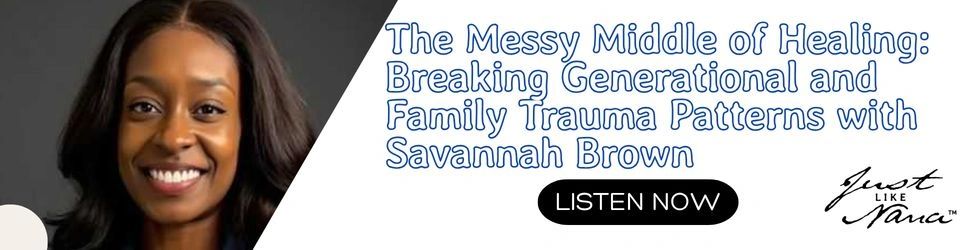
Savannah Brown talks about the mental and emotional tolls of breaking generational trauma patterns.
The reality is that breaking trauma cycles isn’t a clean, linear process—it’s messy, imperfect, and requires an incredible amount of somatic awareness and radical self-honesty to move forward.
About Savannah
An Army veteran and police officer, Savannah is also a student obtaining a Master’s in Social Work. She is the author of In the Wake of Wounds: A Soul’s Revival, a raw and unfiltered look at her personal journey through grief and the complexities of family dynamics.
Finding the Threads of Healing in the Messy Middle: My Conversation with Savannah Brown
There is a profound beauty in the transition of seasons. As we move into spring, we see the earth literally pushing through the mud to find the light. It’s messy, it’s uncoordinated, but it is undeniably full of promise. This sense of new life felt like the perfect backdrop for my conversation with Savannah Brown.
At Just Like Nana, we talk a lot about ancestral trauma—how it lives in our bodies, how it shapes our choices, and how we can begin the work of untangling it. I always start our episodes with a reminder: I am not a mental health professional. I am a curator of stories and information. My goal is for you to listen to our guests, take the threads that resonate with you, and ignore the rest. You are the absolute expert on your own family line, and Savannah Brown’s story is a testament to the power of reclaiming that expertise.
Savannah is a woman of many titles—Army veteran, police officer, social work student, mom, and author of In the Wake of Wounds: A Soul’s Revival. Our conversation was raw and unfiltered.
The Messy Middle of Healing
One of the first things Savannah said that struck me was about the nature of the healing journey. We often want healing to be a clean, linear ascent—a “before and after” photo where the “after” is perfectly curated. But Savannah reminded us that the reality is the messy middle.
She spoke about the difficulty of breaking generational cycles while still living in the world. For Savannah, that meant realizing that the patterns of domestic violence she witnessed in her childhood weren’t just “unfortunate events”; they were blueprints she had subconsciously followed into her own adult relationships. Breaking those patterns isn’t a single decision; it’s tiny choices made every day.
As she put it so beautifully, “We’re all just living our own messy lives. It’s not cookie-cutter.” There is so much permission in that statement. If you feel like your healing is undeveloped or crude, Savannah wants you to know that you are right on schedule.
Somatic Awareness: Listening to the Body’s Alarm
We also discussed the physical reality of trauma. Because of Savannah’s background in law enforcement and her studies in social work, she has a unique perspective on how the body stores stress. She shared how her job often required her to suppress her emotions—to be the stoic presence in a crisis—which only moved the trauma deeper into her body.
We talked about the importance of somatic awareness. This looks like naming the physical sensation in the moment. When our heart starts to race or our chest feels tight, we can choose to not just push through it anymore. We can pause and acknowledge it. This is a crucial step in regulating the nervous system. When we stop to name the physical response, we signal to our brain that we are aware of the “alarm,” and we can begin to step out of the fight-or-flight cycle that so often dictates the lives of those carrying ancestral trauma.
Conscious Parenting as Radical Healing
Perhaps the most inspiring part of Savannah’s journey is how she is infusing her healing into her parenting. She is practicing what many call “re-parenting.” By giving her child the patience, safety, and emotional space she didn’t always have, she is simultaneously healing the little girl inside of her who was denied those things. She is ensuring that her child starts his life with a lighter load. She isn’t just protecting him; she is changing the trajectory of her family line.
Choosing People Who Choose You
As we wrapped up our conversation, I shared two lines from Savannah’s book: “May you choose people who choose you and enter every room like your ancestors sent you.”
The first half—choosing people who choose you—is a radical act for anyone who has grown up in a family system defined by conditional love or instability. It means prioritizing reciprocity. It means having the courage to set boundaries with people—even family—who do not support your peace.
The second half is about ancestral sovereignty. Even when we are breaking the negative cycles of our ancestors, we can still call upon their strength. We are the sum of those who came before us—the ones who survived, the ones who loved, and the ones who hoped. When you enter a room, you aren’t just there as an individual; you are there as the culmination of generations of resilience. You belong in that room because you are the one who is finally doing the work to make it a better place for those who come after you.
I hope you’ll take a moment to listen to Savannah’s full story. Let her words be a thread you pull on for your own healing. And remember, as we navigate this messy middle together, be kind to yourself. The earth doesn’t bloom overnight, and neither do we.
Resources Mentioned
I connected with Savannah on #PodMatch.
Connect with Savannah
In The Wake of Wounds: A Soul’s Revival
Connect with the Show
We’d love to share your family story.
- Website: justlikenana.com