
Sub-Total: $0.00
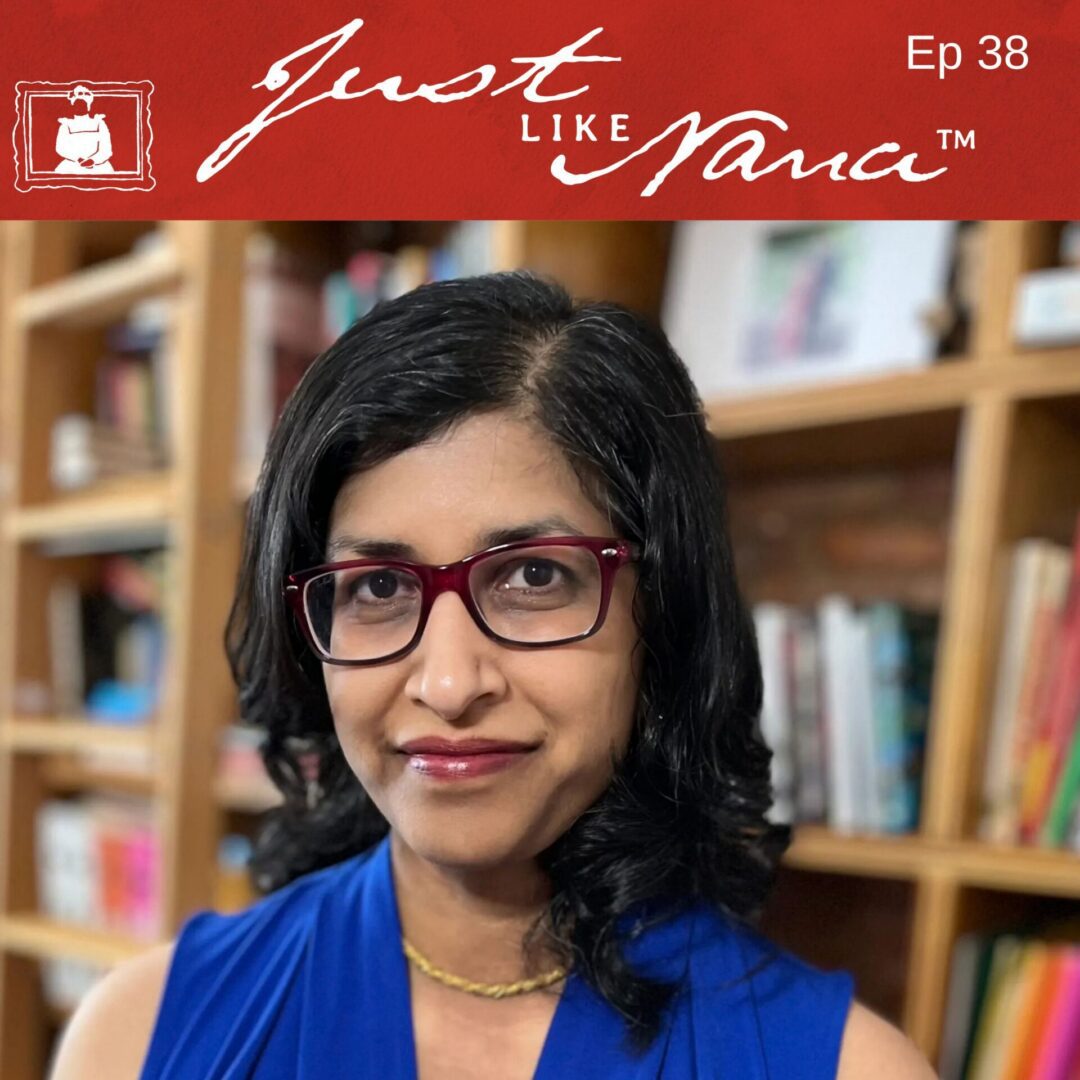
Meghana Nayak is here to discuss how catastrophic political events, such as Partition, trigger epigenetic tags, physical health vulnerabilities, and systemic family silences that echo across generations. She also explores how examining perpetrator legacies, engaging in political solutions, and honoring non-linear storytelling can help us realign inherited cycles, heal ancestral burdens, and restore true collective resilience.
About Meghana
Meghana V. Nayak is a Professor of Political Science and Chair of the Women’s and Gender Studies Department at Pace University-NYC. Her research, teaching, and advocacy focus on gender and racial violence, particularly against migrant communities. With Sara Shroff, she co-edits the Conversations section of the International Feminist Journal of Politics, where they curate a special series on restorative and reparative dialogues.
Legacy Burdens, Epigenetics, and Realigning the Cycle
On the latest episode of Just Like Nana, I sat down with Meghana Nayak. Meghana is a political science professor, researcher, human rights scholar, and the author of the novel Tilt. Her work dives into the complicated, overlapping spaces of intergenerational trauma, family secrets, political violence, and historical displacement.
What is Intergenerational Trauma?
When asked how she defines intergenerational trauma, Meghana described it as an ancestral residue or a legacy burden—something you are holding that is simply not yours to hold. Drawing from the wisdom of Indigenous social worker Dr. Maria Yellow Horse Braveheart, Meghana highlighted trauma as a “soul wound” accumulated across generations.
To illustrate how this manifests, Meghana used the historic example of the 1947 Partition of India. After two centuries of British colonial rule, arbitrary lines were drawn across the region, displacing millions of people, triggering widespread violence, and fracturing countless family lines overnight.
The catastrophic stress of Partition didn’t just end when the borders were drawn. The survivors developed habitual coping mechanisms—silence, emotional suppression, hypervigilance, and patriarchal rigidity—to create a sense of order amid chaos. Those coping mechanisms were then passed down to their children and grandchildren.
Epigenetics and the Body’s Memory
Intergenerational trauma isn’t just psychological; it alters our physical bodies.
During British rule in India, enforced famines killed millions of people. Modern medical research shows that those catastrophic starvation events left epigenetic tags on the survivors’ genes. Across generations, these genetic tags altered how descendants process and store fat, leaving modern South Asians significantly more susceptible to diabetes and cardiovascular illness.
Even if your family never spoke a word about historical catastrophes, your physical nervous system and cellular health carry the memory of what your ancestors endured.
Realigning the Cycle vs. “Breaking” It
One of the most powerful shifts Meghana shared came from the Asian Mental Health Collective: What if we stop talking about “breaking” the cycle and start talking about realigning the cycle?
When we focus solely on “breaking” cycles, we can inadvertently pathologize our families or view ourselves as damaged. Realigning the cycle means choosing to relate to one another differently. It means replacing silence with truth, replacing violence with boundaries, and replacing estrangement with authentic connection or chosen family.
It also means recognizing that your anxiety, panic, or eating struggles aren’t proof that you are broken. They are natural responses to a massive historical weight that was too heavy for any single body to hold.
Perpetrator Legacies and Political Healing
True lineage work requires us to look at the full picture of our heritage. Meghana spoke candidly about examining her own caste and class privileges alongside her colonized roots. Similarly, we must look at how our ancestors may have benefited from white supremacy, settler colonialism, or systemic oppression.
Acknowledging perpetrator legacies isn’t about wallowing in unproductive guilt or shame. It’s about understanding the full context of our lives so we can participate in real political and structural solutions. Ending intergenerational trauma isn’t just an individual mental health journey—it requires us to stand in solidarity against ongoing systemic violence, displacement, and oppression today.
The Magic of Uncovering Stories
While writing Tilt, Meghana created a fictional plot point where a child was raised by another family member because the parents couldn’t care for them. It wasn’t until after the book was published that Meghana discovered the exact same thing had happened to her own father as a child—a secret no one had ever shared with her.
Our bodies intuitive sense knows when a story is missing. By reading, writing, asking questions, and honoring non-linear stories, we help heal the past and build a new path forward.
What ancestral story or legacy burden are you holding today, and how can you begin to realign that cycle with compassion?
Resources Mentioned
- Caste: The Origins of Our Discontents by Isabel Wilkerson: https://bookshop.org/p/books/caste-the-origins-of-our-discontents-isabel-wilkerson/ba07006a708c5070?ean=9780593230275&bkshp-astro=t
- My Grandmother’s Hands – Resmaa Menakem: https://bookshop.org/p/books/my-grandmother-s-hands-racialized-trauma-and-the-pathway-to-mending-our-hearts-and-bodies-resmaa-menakem-msw-licsw/0cb0feaebf37caff?ean=9781942094470&bkshp-astro=t
- What My Bones Know – Stephanie Foo: https://bookshop.org/p/books/what-my-bones-know-a-memoir-of-healing-from-complex-trauma-stephanie-foo/916e2e6fdff307fd?ean=9780593238127&next=t&utm_source=google&utm_medium=cpc&utm_campaign=%7Bcampaignname%7D&utm_content=6443417794&gad_source=1&gad_campaignid=16235479093&gbraid=0AAAAACfld42wm3ZJYOrS192gzz20OPUOL&gclid=CjwKCAjwyYPOBhBxEiwAgpT8P353Fr1ludibZnz305XmuimN8dbxEz4KYcG_sFKBVNuexJAUxJkqshoC0ukQAvD_BwE
- Nervous – Jen Soriano: https://bookshop.org/p/books/nervous-essays-on-heritage-and-healing-jen-soriano/2f4c4478c25488a3?ean=9780063230149&bkshp-astro=t
- Dr. Maria Yellow Horse Brave Heart: https://en.wikipedia.org/wiki/Maria_Yellow_Horse_Brave_Heart
- Asian Mental Health Collective: https://www.asianmhc.org/
Connect with Meghana Nayak
Website: https://meghanavnayak.com/
Tilt on Bookshop.org: https://bookshop.org/p/books/tilt-a-novel-on-intergenerational-trauma-meghana-v-nayak-pace-university/ddeab0acb38fb2c4?ean=9781538187425
Connect with the Show
- Website: justlikenana.com
- Share Your Story: If you have a family story or trauma you’re exploring, reach out via our website for a chance to be interviewed.