
Sub-Total: $0.00

Juliet Patterson is the author of Sinkhole: A Legacy of Suicide, which explores how suicide shaped her family line. She also discusses how breaking generational silences, reconnecting with the land and local communities, and cultivating somatic awareness can help us heal inherited grief and reclaim our true sense of belonging.
About Juliet
Juliet Patterson is the author of Sinkhole: A Legacy of Suicide (Milkweed Editions, September 2022), finalist for the 2023 Minnesota Book Awards and named one of the best memoirs of 2022 by Library Journal. She has also published two full-length poetry collections, Threnody, (Nightboat Books 2016), a finalist for the 2017 Audre Lorde Poetry Award, and The Truant Lover, (Nightboat Books, 2006), winner of the Nightboat Poetry Prize and a finalist for the 2006 Lambda Literary Award. A recipient of the Arts & Letters Susan Atefat Prize in non-fiction, and a Lynda Hull Memorial Poetry Prize, she has also been awarded fellowships from the Jerome Foundation, the Minnesota State Arts Board, and the Minneapolis-based Creative Community Leadership Institute (formerly the Institute for Community and Creative Development). She teaches creative writing at St. Olaf College and Augsburg University’s low-residency MFA program. She lives in Minneapolis with her family.
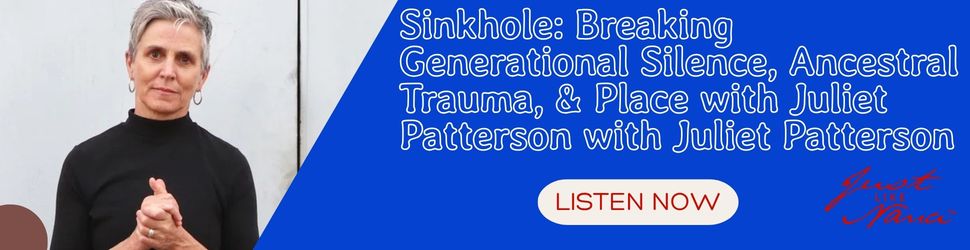
Sinkhole: Breaking Generational Silence, Ancestral Trauma, & Place with Juliet Patterson
Before we dive in, I want to acknowledge that our conversation on the latest episode of Just Like Nana discusses the topic of suicide. If this feels like too much for you today, please honor your boundaries and take care of yourself. If you or someone you know is struggling or in crisis, please remember that help is available by calling or texting the Suicide & Crisis Lifeline at 988.
My guest is Juliet Patterson—an acclaimed poet, professor, and author of Sinkhole: A Legacy of Suicide, which was named a finalist for the Minnesota Book Award and one of the best memoirs of the year by Library Journal. Juliet’s memoir chronicles an incredible, heartbreaking family story: her father died by suicide in 2009, and both of her grandfathers—her mother’s father and her father’s father—also died by suicide.
Inherited Grief: Feeling What Cannot Be Spoken
When Juliet was growing up, the deaths of her grandfathers were shrouded in complete, impenetrable silence. She didn’t learn the truth about how her grandfathers died until she was into her twenties.
Yet, long before she knew the historical facts, Juliet felt the heavy weight of what she calls inherited grief. Because her parents had never fully processed their own childhood trauma and loss, that unexpressed grief didn’t vanish. It lived in the quiet corners of their home, in the unspoken family rules, and inside Juliet’s own body.
Unaddressed family secrets and shame act like emotional static in a home. Children, who are naturally intuitive and somatic beings, pick up on that unspoken tension. When family systems default to erasure—cutting off their ethnic roots, disowning painful stories, and hiding behind a polished surface—it creates a deep fracture at the soul level.
The Sinkhole as a Living Metaphor
The title of Juliet’s memoir, Sinkhole, comes from her time researching her family’s roots in Pittsburg, Kansas—a historic coal-mining epicenter. While exploring the town where her family had lived, she encountered physical sinkholes caused by centuries of deep, underground mining.
That sinkhole became a profound metaphor for her father’s life and the lives of her grandfathers. On the surface, everything looked intact, normal, and quiet. But underneath, a massive, hidden void was eroding the foundation, until eventually, the surface collapsed.
Somatic Healing, Place, and the Earth
So, how do we begin to heal inherited grief without being swallowed up by it?
Juliet highlights our fundamental nature: we are deeply mammalian beings. Modern, fast-paced life and Western medical models have severed our minds from our physical bodies, cutting us off from the natural world.
When Juliet traveled back to the landscape of Kansas to write her book, returning to the fields and horizons where her ancestors walked, she felt a profound sense of grounding and belonging. Being in that physical place allowed her to grieve openly in a way her everyday life wouldn’t permit.
To heal intergenerational wounds, we must move beyond rigid surface “roles”—the performative scripts we play as dutiful daughters, strong fathers, or pleasing mothers—and drop back into our physical bodies.
- Practice Daily Somatic Awareness: Pause during your day and ask yourself where you are holding tension. What does your grief, anger, or fear feel like physically in your chest, belly, or throat?
- Connect to the Land: Step outside, place your feet on the bare earth, or sit under a tree. Nature provides a massive, steady container capable of holding heavy human grief when our personal systems feel overwhelmed.
- Break the Silence: Speak your truth gently. You don’t need to fix your entire ancestral line, but using words to express genuine feelings releases the pressure valve of family secrecy.
When you step out of performative family roles and listen to your body today, what unspoken story or heavy weight are you ready to lay down on the earth?
To pick up a copy of Juliet’s remarkable memoir, Sinkhole: A Legacy of Suicide, visit your local independent bookstore or bookshop.org.
Resources Mentioned
- Jonathan Foer: https://www.climateone.org/people/jonathan-safran-foer
- bell hooks All About Love: https://www.blackgarnetbooks.com/item/2QHtVTCGJR-y-vmDK_S93w
- Pema Chödrön: https://pemachodronfoundation.org/
Connect with Juliet Patterson
Website: https://www.julietpatterson.com/
Books: https://milkweed.org/book/sinkhole
Connect with the Show
- Website: justlikenana.com
- Share Your Story: If you have a family story or trauma you’re exploring, reach out via our website for a chance to be interviewed.